Brain Network Analysis
Demo#
Overview#
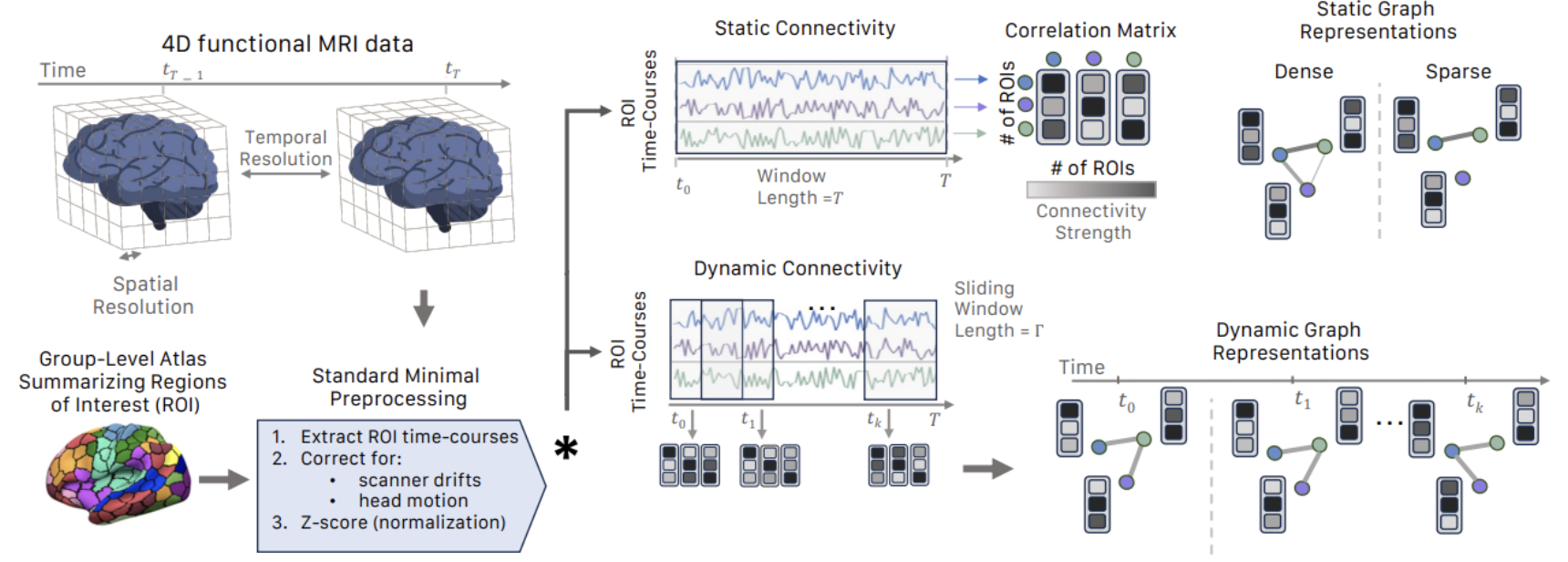
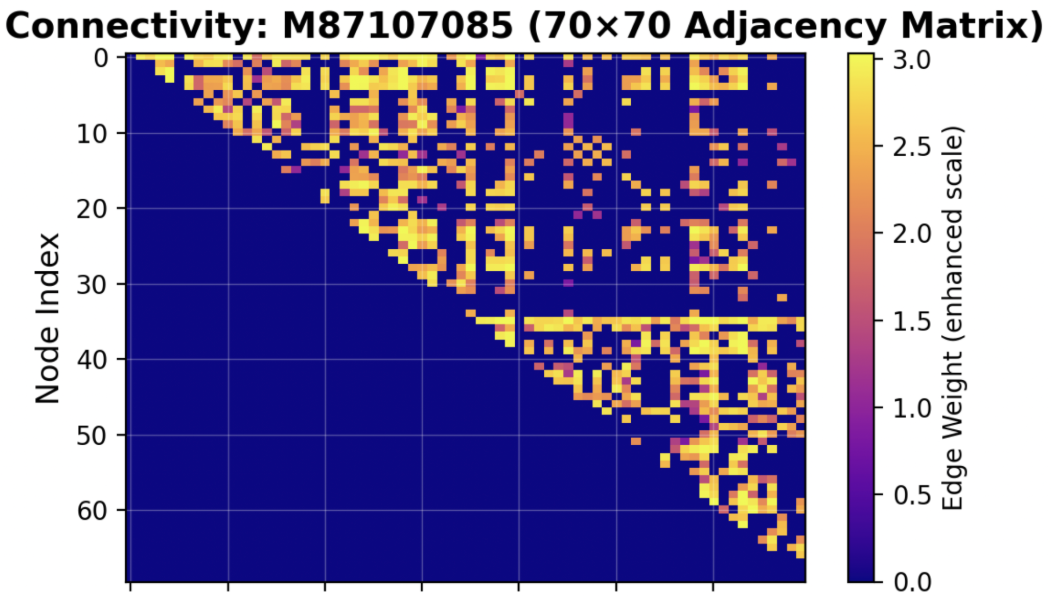
Brain Network Analysis is a comparative study of classical machine learning and Graph Neural Network (GNN) approaches for classifying brain connectivity patterns across different demographic and cognitive traits. The project analyzes two datasets of vastly different scales: the CMU Cognitive Creativity dataset (114 subjects with 70×70 functional connectivity matrices) and the NeuroGraph HCP dataset (1200+ subjects with fMRI-derived graphs). Using baseline models including SVM, Random Forest, KNN, XGBoost, and MLP, alongside deep learning architectures like Graph Convolutional Networks (GCN) and various GNN backbones from PyTorch Geometric, the study classifies subjects by gender, mathematical ability, and creativity level. The research demonstrates that classical ML methods (particularly SVM achieving 78% accuracy) outperform GNNs on small datasets, while GNNs exceed 80% accuracy and surpass traditional approaches when trained on large-scale data. The project combines graph representation learning, visualization of adjacency matrices, and feature importance analysis to identify which brain regions and connectivity patterns are most informative for each classification task.
Why#
Understanding how patterns of brain connectivity relate to behavioral and cognitive traits such as gender, mathematical ability, and creativity is a central challenge in modern neuroscience. Traditional machine learning approaches treat connectivity matrices as high-dimensional vectors, discarding the underlying graph structure and relationships between individual connections. Graph Neural Networks are better suited to preserve and leverage graph topology, enabling models to learn hierarchical, spatially coherent representations of connectivity. This project investigates the critical question: under what conditions do GNNs provide meaningful improvements over classical ML methods in brain network classification tasks? By contrasting small-scale and large-scale datasets, I aimed to provide practical guidance for neuroimaging-based classification pipelines and move beyond “black-box” prediction toward interpretable findings that can be related to known neural circuits underlying reasoning, problem-solving, and creative thinking. The results offer crucial methodological insights for researchers choosing between traditional and graph-based deep learning approaches in brain connectivity analysis.